“Putting the customer first” is in the motto of many companies, governments and institutions. But do you live up to it? Does customer satisfaction really rise, and do you know what sets you apart? Putting the customer first starts with one shift: not looking inside-out, at what you deliver, but outside-in, at what the customer experiences.
Inside-out, or outside-in
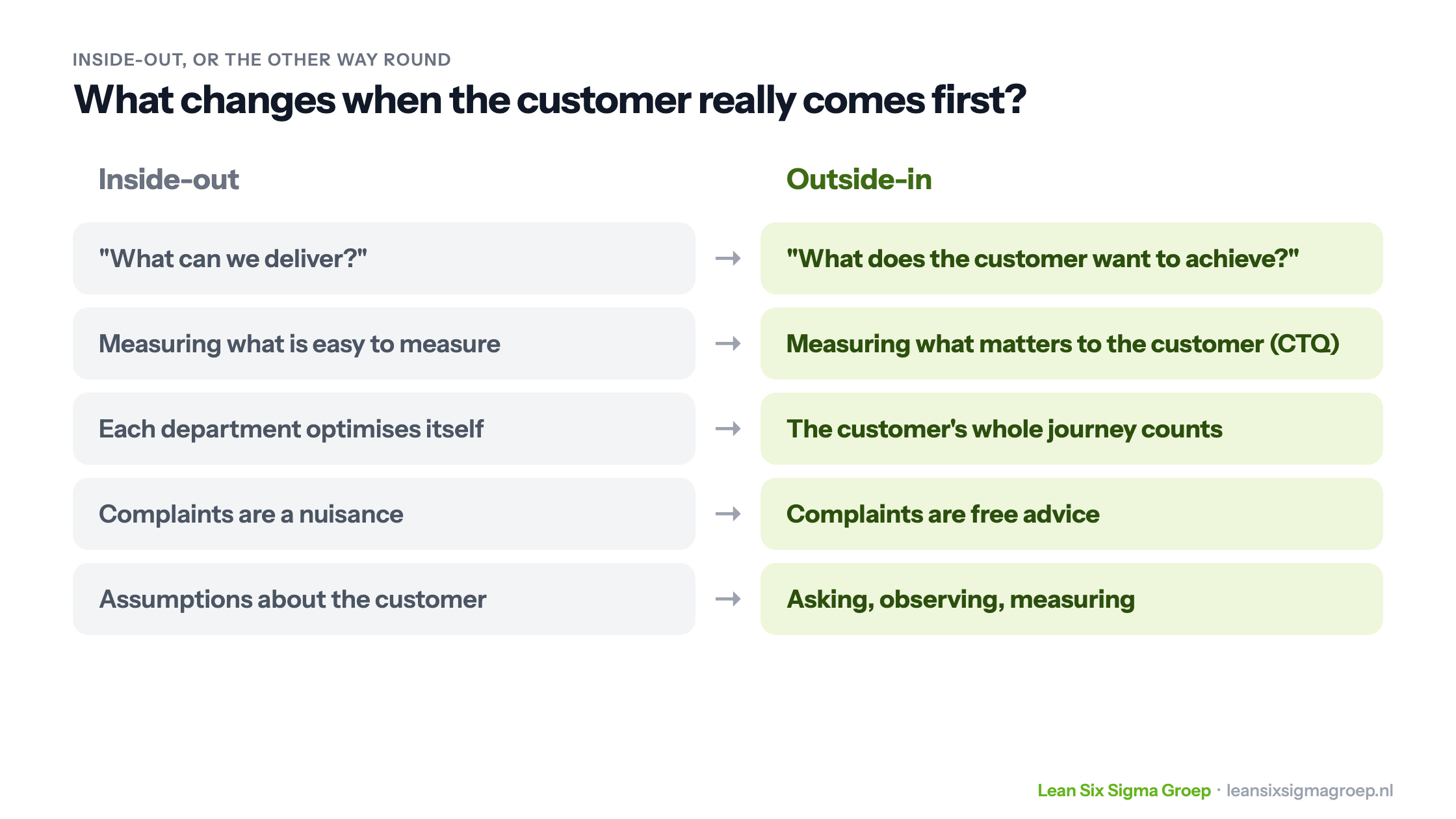
Many organisations say they put the customer first, yet still look from the perspective of their own departments: what can we deliver, how fast is our step? Each department optimises itself, while the customer experiences the whole journey. Looking outside-in means starting from what the customer wants to achieve, measuring what matters to the customer, and seeing complaints as free advice. The overview further down lists the differences.
What does the customer want?
The central question is: what is the added value for the customer? For that you need to hear the customer: the Voice of the Customer. That can be done with interviews, focus groups, surveys, complaint analysis or simply by watching how customers use your product. From this you derive what is Critical to Quality: the measurable characteristics that determine whether the customer is satisfied.
Not every wish carries the same weight. The Kano model helps distinguish what is a basic requirement (if it is missing, the customer is dissatisfied), what is better the more there is of it, and what surprises and delights the customer.
The Consumption & Provision Map
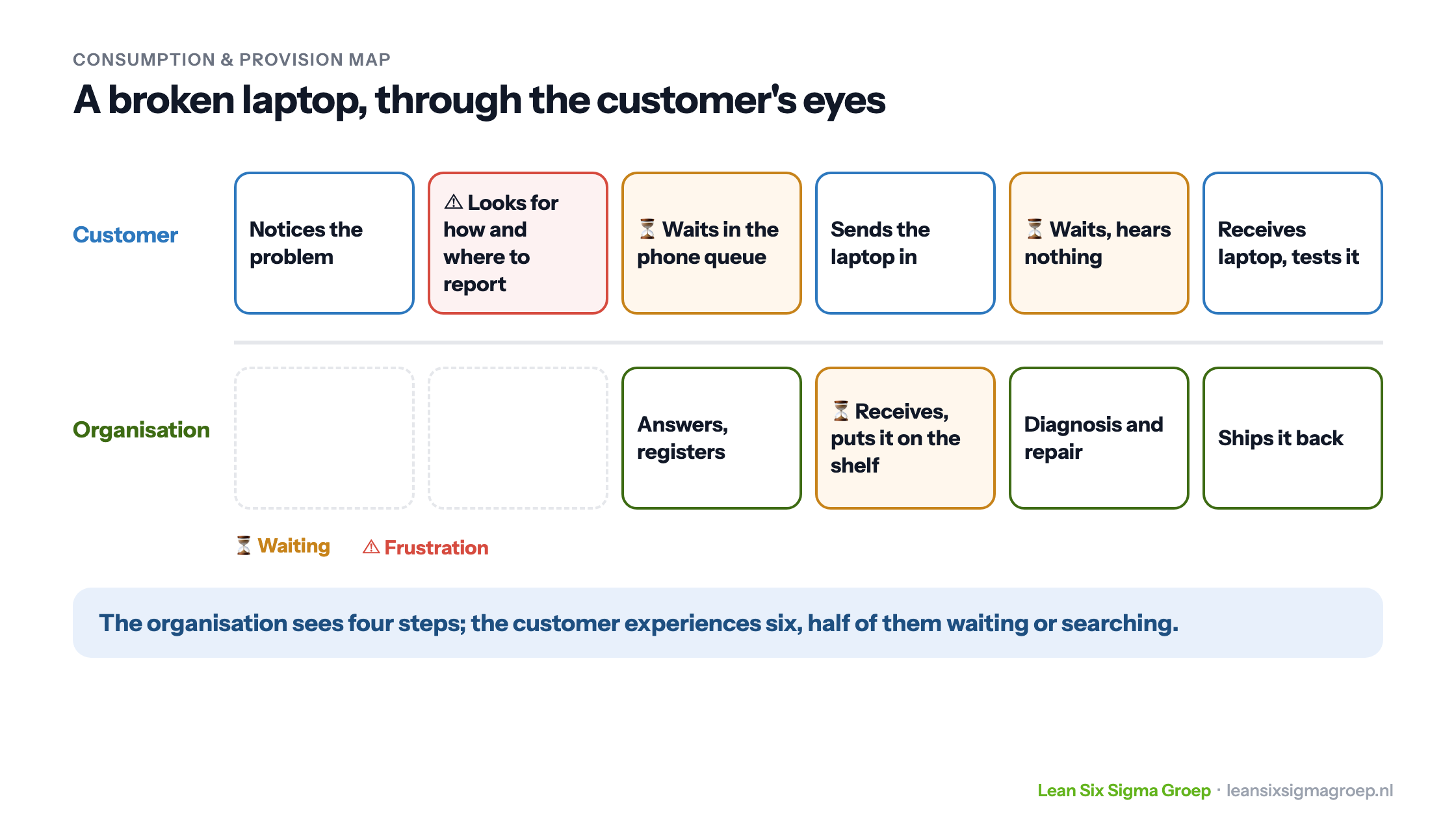
A powerful tool for seeing the process through the customer’s eyes is the Consumption & Provision Map, described by James Womack and Daniel Jones in Lean Solutions (2005). You draw two lines one below the other: at the top all the steps the customer goes through (consumption), at the bottom what the organisation does at that moment (provision). It resembles a customer journey, but puts customer and organisation directly side by side.
In the example at the top of this article the organisation sees four steps in repairing a laptop. The customer experiences six, and half of them are searching or waiting. That is exactly where the opportunities for improvement lie: a clear place to report the problem, a call-back appointment instead of a queue, a message when the laptop has arrived.
Not only the external customer
Besides the paying customer there are internal customers: the colleague or department waiting for your work. Staff and society have wishes too, for example on sustainability. An organisation that puts the customer first takes them into account as well.
Lean Six Sigma helps put the customer first
Lean Six Sigma always starts with the customer. With Lean you determine which steps in your process add value for the customer and which don’t. The latter are waste, such as waiting, transport, errors and rework, and you remove as much of it as you can. Six Sigma makes the process reliable on the points the customer cares about.
Improvement follows five steps, according to DMAIC: define the problem, measure, analyse, improve and control. In every step the question remains: what does the customer notice?
You can measure whether it works with customer satisfaction or the Net Promoter Score. To divide customers into groups, read more in customer analysis.
Want to know more?
In the Green Belt course you learn to define and implement improvements based on the voice of the customer. For a compact route there is the Green Belt Bootcamp. Lean Six Sigma Groep also supports organisations with in-company training.