Why customer focus often goes wrong
Working customer-focused sounds simple: you just make what the customer wants. But often customers don’t know exactly what they want. Or they think they do, but mean something else. You adjust your process, add a feature or speed up delivery, and still the complaints come in.
Before you can map customer wishes properly, you first need to understand who your customers are. What kinds of customers do you serve? What are their goals, their situation, their frustrations? Only when that is clear can you really start improving with the customer in mind.
This ties in with the first principle of Lean: value, seen through the customer’s eyes. Improvement doesn’t start with what you think is important, but with what your customer values. And that often differs per target group.
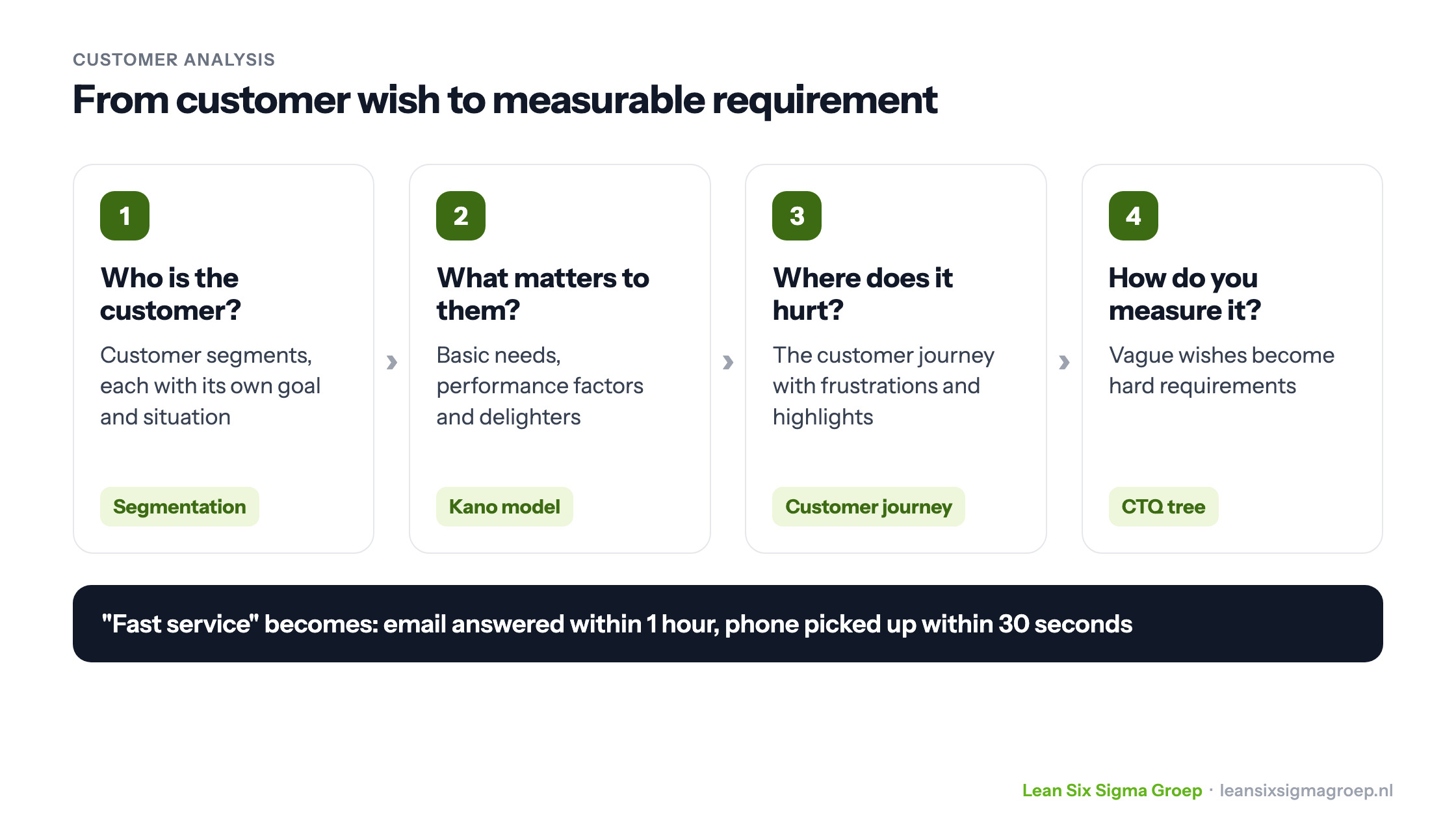
Understanding customer wishes is not an exact science. It is more like a board game in which everyone plays by their own rules. Still, with a good customer analysis and the right tools you can find out much better what your customer really values. The image at the top of this article shows the steps.
What matters to the customer? The Kano model
The Kano model, devised in 1984 by the Japanese professor Noriaki Kano, shows how customer needs relate to satisfaction. It distinguishes three main types of needs:
- Basic needs: so obvious that nobody mentions them as long as they are met, such as a working website or a clean hotel room. If they go wrong, the customer is immediately dissatisfied.
- Performance factors, such as delivery time or response speed: the better you score, the more satisfied the customer.
- Delighters: unexpected extras nobody asks for, but that are greatly appreciated, such as a personal note with an order.
The Kano model mainly helps you set priorities when you (re)design a product or service: where does your effort have the most effect on satisfaction?
Where does it hurt? The customer journey
Where the Kano model shows what customers want, the customer journey shows how customers experience your process. You map the whole journey, from first contact to aftercare.
Imagine a customer who wants to take out insurance. They visit your website, have to search for a long time, request information via a form (which never gets a response), then call themselves and end up in a phone menu seven levels deep. Hardly a great experience.
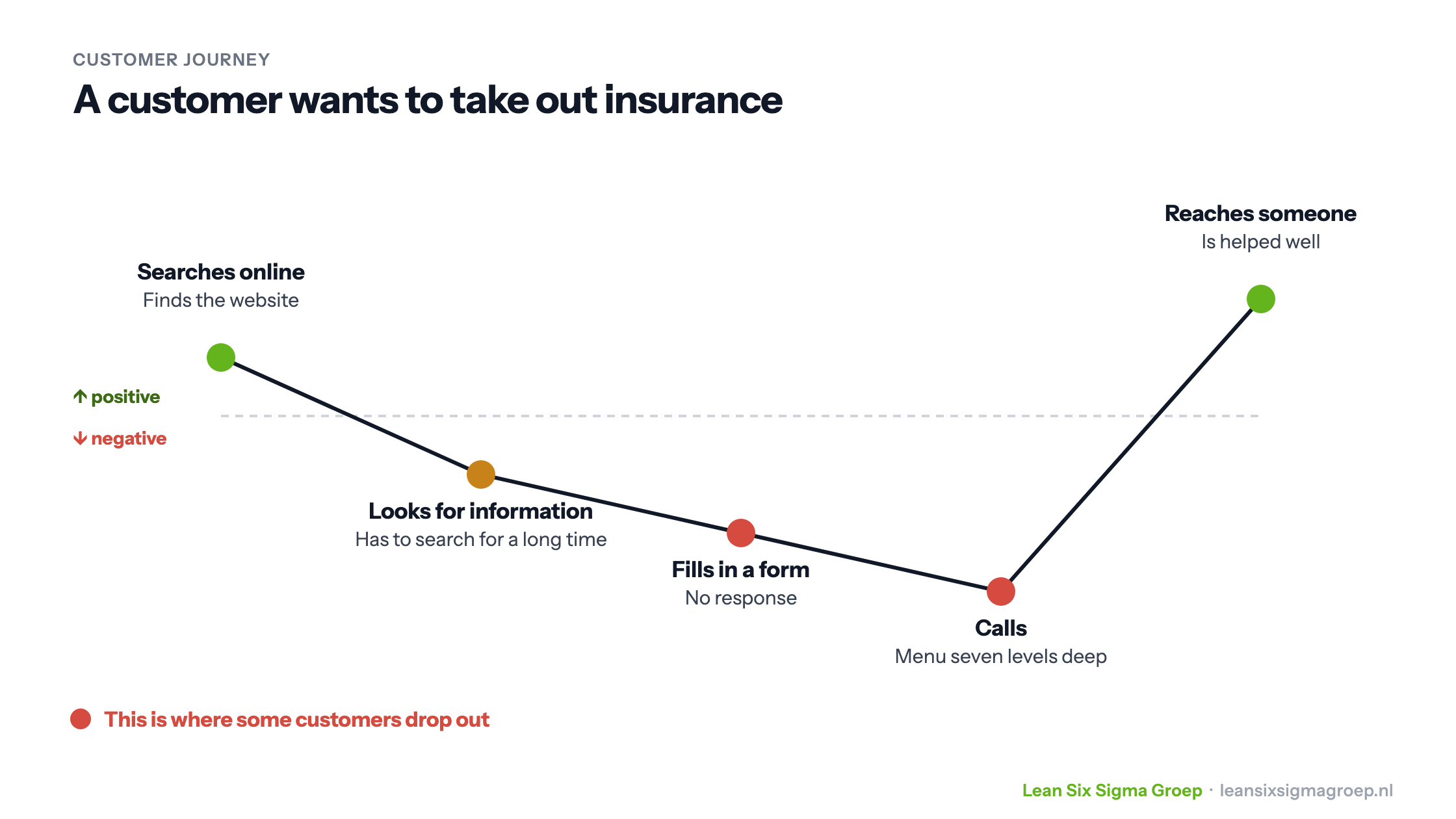
By making the customer journey visible, you discover where customers get stuck, drop out or are pleasantly surprised. That makes the customer journey ideal for improving existing processes.
From insight to action: the CTQ tree
Once you know what the customer wants and where it hurts, you translate those insights into concrete, measurable requirements. For that you use the CTQ tree (Critical to Quality).
Take a common wish such as “fast service”. It sounds good, but what does it mean exactly? In the CTQ tree you translate it into measurable requirements, such as “emails answered within one hour” or “phone picked up within 30 seconds”. That makes vague wishes tangible, and usable as success criteria in your Lean Six Sigma project. The raw customer statements you start with are called the Voice of the Customer.
Kano or customer journey: when to use which?
Both tools are valuable, but serve a different purpose. Use the Kano model when you want to know which needs have the most influence on satisfaction, for example when developing a new product or deciding where to invest. Use the customer journey when you want to improve an existing process and see how customers experience it.
Smart organisations combine both: first map the customer journey, then use Kano to decide which improvements have the most effect.
Customer-focused improvement starts with really listening
Customer focus is not about running harder, but about looking smarter. By analysing customer wishes and understanding the customer journey, you lay a solid foundation for improvements that really make a difference. Whether you are just starting a Lean Six Sigma programme or are already in the middle of a project.
Want to learn how to apply these tools in your organisation? Take a look at the Green Belt or Black Belt training course.