
What is the Net Promoter Score (NPS)?
The Net Promoter Score, often abbreviated to NPS, is a powerful tool for measuring customer loyalty. It gives businesses a simple yet effective way to gauge customer satisfaction by asking how willing customers are to recommend a product, service or organisation to others.
NPS is expressed as a number between -100 and 100, with a higher score indicating greater customer satisfaction.
How does NPS work?
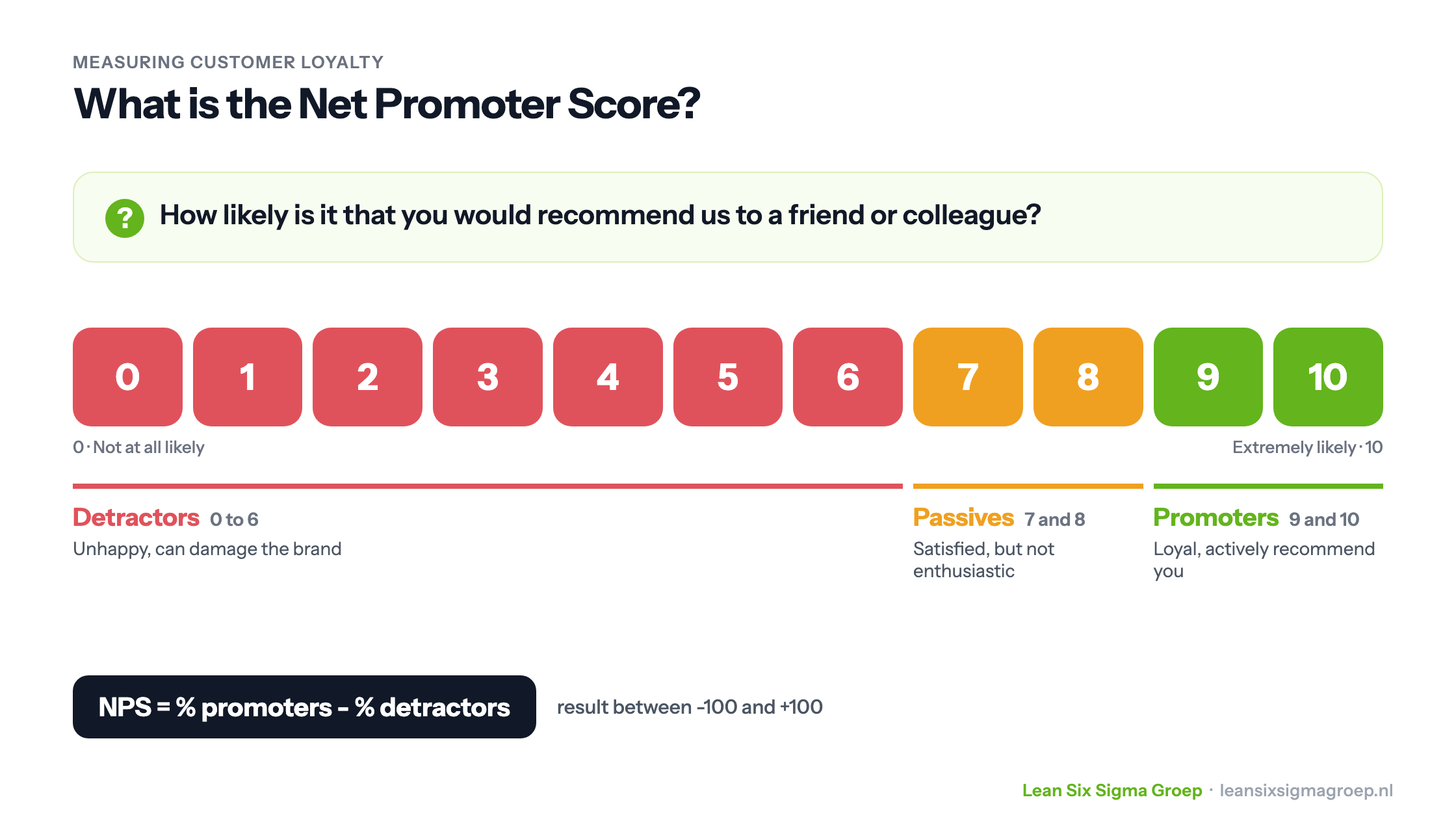
NPS is calculated from one specific question: “How likely is it that you would recommend our company, product or service to a friend or colleague?” Customers give a score from 0 (not at all likely) to 10 (extremely likely). Based on their answers, customers are grouped as:
- Promoters (score 9-10): Loyal customers who are very satisfied and likely to spread positive word of mouth.
- Passives (score 7-8): These customers are satisfied, but not enthusiastic enough to count as promoters.
- Detractors (score 0-6): Unhappy customers who may share negative experiences and can damage the brand.
NPS is calculated by subtracting the percentage of detractors from the percentage of promoters.
You then calculate the NPS as follows:
- Work out what percentage of your customers are promoters.
- Work out what percentage of your customers are detractors.
- Subtract the percentage of detractors from the percentage of promoters.
You now end up with a number between -100 and +100. Naturally, you want your NPS to be as high as possible.
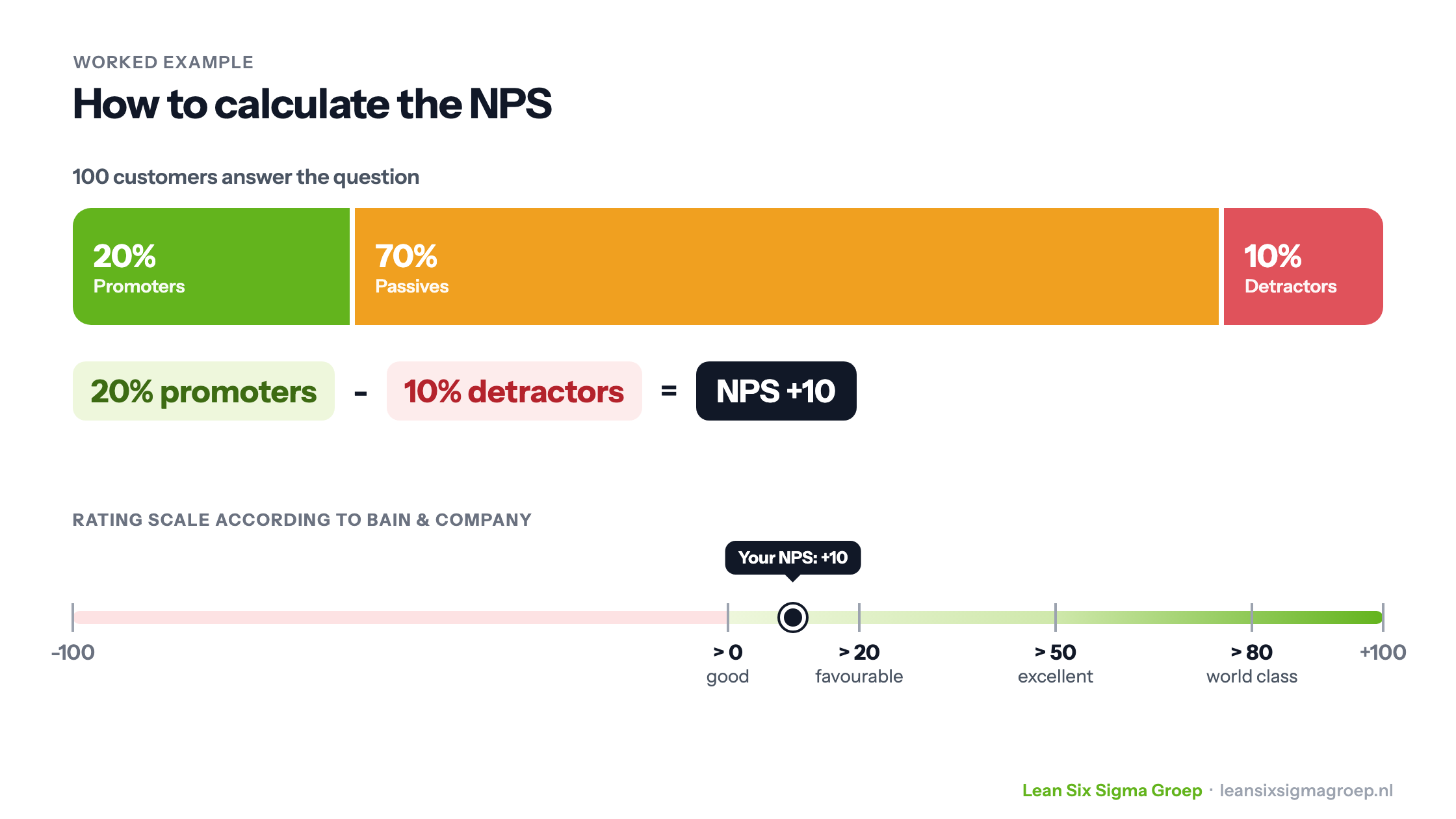
Example: say you have 20% promoters and 10% detractors, then your NPS is +10. The percentage of passives does not count in the calculation.
What does a good NPS look like?
According to Bain & Company, where Fred Reichheld developed NPS, the following scale applies:
- Above 0 is good
- Above 20 is favourable
- Above 50 is excellent
- Above 80 is world class
It is important to understand, however, that a “good” NPS can vary between industries and regions, and that it tells you more as a comparison with competitors and over time than as an absolute value.
Relational vs. transactional NPS
There are two main types of NPS survey:
- Relational NPS: These surveys are run periodically (annually, for example) to get an overall picture of customer satisfaction and see how it changes over time.
- Transactional NPS: This is run straight after a customer interaction, such as a purchase or a call with customer service. This gives useful information about specific touchpoints, but says less about the customer relationship as a whole. Use it alongside relational NPS, not instead of it.
Why NPS matters
NPS is not just a measure; it is a tool that helps businesses understand where and how they can improve their customer interactions. By running NPS surveys regularly, businesses can identify where problems arise in the customer journey and work proactively on solutions.
Combining NPS data with other customer data gives a fuller picture that helps steer business strategy and improve customer loyalty.
Why does NPS work so well?
One of the main reasons NPS works well is that customers can fill it in quickly. You get responses back much faster and the response rate is much higher than for longer surveys, and the answers are more reliable too.
The longer the survey, the greater the chance that customers give up halfway or give the same answer to every question so they can click through faster. With NPS, customers are done within a minute.
Above all, though, NPS works well for testing your customers’ loyalty because of the way the question is framed. To recommend a product or service to others, you obviously need to be satisfied with it, but you also need to be so enthusiastic about it that you are willing to attach your own reputation to it.
Many organisations believe customers are loyal as long as they keep ordering. But in many cases there turns out to be a completely different reason behind those repeat orders. The customer may simply be unable to find a better option, or may simply not care enough about the product or service to look for alternatives.
These customers obviously account for part of your revenue, but they will not help you win more customers.
Promoters, on the other hand, are far more loyal and also recommend your organisation (for free and with enthusiasm). The more promoters you have, the more word of mouth you get and so the greater your expected growth.
Is NPS criticised?
Alongside the many positive experiences with NPS, there are also some drawbacks.
For one, the method works differently from culture to culture. It is simply a fact that Americans are quicker to give a high score than, say, the Dutch. For the Dutch, an eight is often already very high, and they will hardly ever give a ten: after all, there is always room for improvement.
NPS will therefore be higher on average in some countries than in others, which makes it hard for international organisations to rely on NPS alone to decide where they can expect the most growth.
The biggest argument against using NPS is that the score gives no direction whatsoever on what you can improve. It only says something about how loyal your customers are, and gives no insight into why certain customers are not loyal.
According to some, you might as well ask a few more questions in your survey so that you gain more insight.
Another big drawback of NPS is the number of measurements needed to say anything reliable. You reduce a scale of 0 to 10 to three groups, and information is lost in the process. To know your NPS to within 5 points, you quickly need 800 to 1,000 responses. Often you simply don’t have that many.
Think of a car dealer asking how you rated the service. He often asks you to give a 9 or 10 as well. That is because you then land in the right box, and there are often hefty bonuses attached to that for him.
So in the end, plenty of measurements matter, and often they just aren’t there.
Conclusion
NPS is a valuable metric for measuring customer loyalty and can give an indication of a company’s growth potential. As with any metric, however, it is important to see it in context and to use it as part of a broader strategy of customer satisfaction measurement and improvement.
Want to learn how to gain insight into what your customers think and want? In our Green Belt training we cover a range of tools that can really help you map out your customers’ needs!