
What is the SERVQUAL model?
SERVQUAL stands for Service Quality. It is a model developed in the 1980s by Zeithaml, Parasuraman and Berry. SERVQUAL lets you pin down the difference between what customers expect and what customers actually experience.
The model comes in handy when customers seem dissatisfied but there is little insight into why. You can also use it to test whether the organisation’s value proposition matches what the paying customer experiences.
What are the five dimensions of the SERVQUAL model?
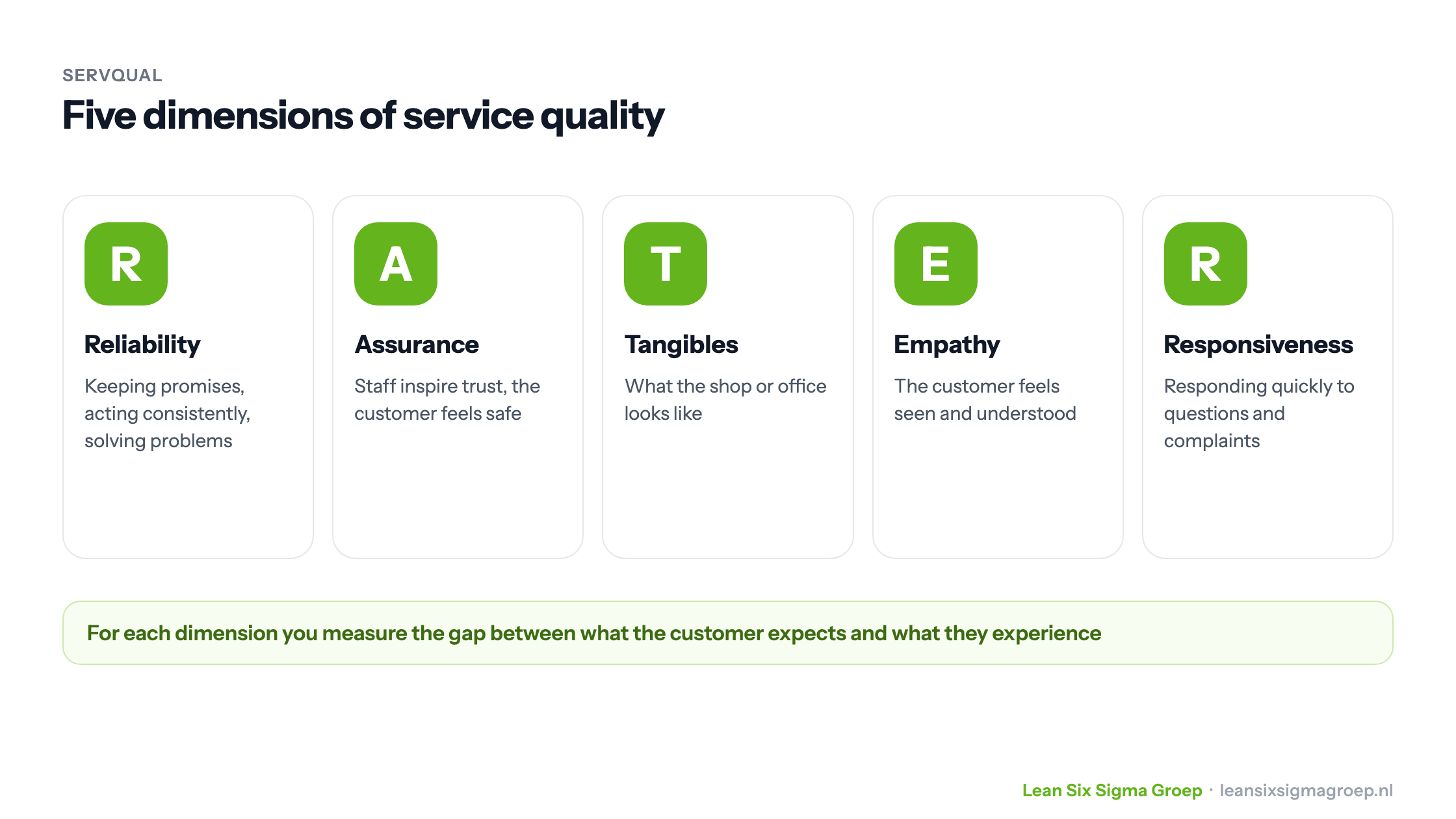
The SERVQUAL model contains five dimensions, each with a set of test questions that show how large or small the gap is. There is a handy mnemonic, RATER (the first letters of the dimensions):
- Reliability: the extent to which the organisation keeps its promises, acts consistently and solves problems.
- Assurance: whether the employees the customer deals with inspire trust and the customer feels they are in safe hands.
- Tangibles: the appearance of the place where the service is delivered (the shop, the office, etc.) and how far it matches what the customer expects.
- Empathy: the extent to which the employee connects with the customer and the customer feels understood.
- Responsiveness: how quickly questions and complaints get a response.
Gap analysis
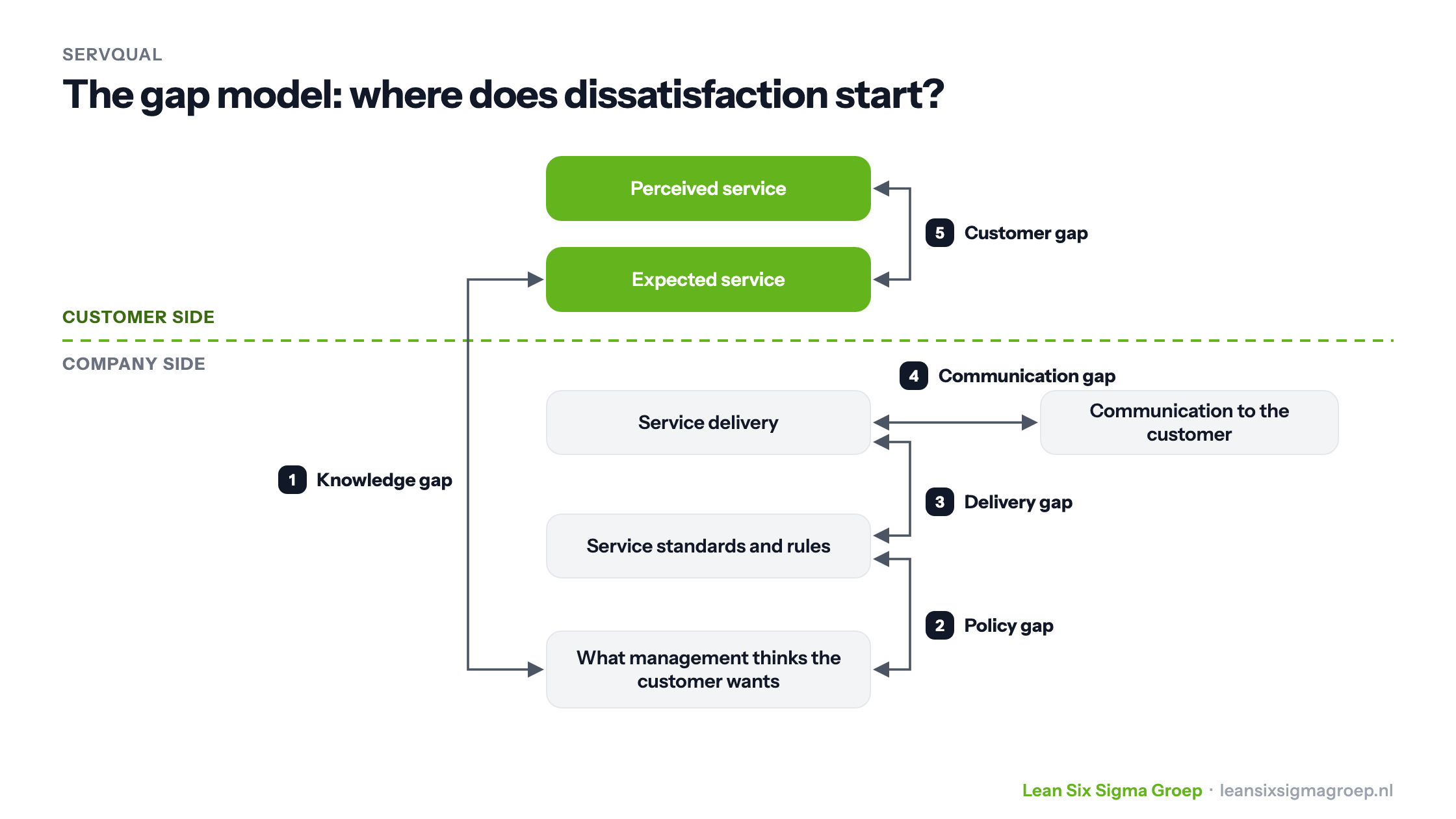
For each of these dimensions there are standard questions that test whether there is a gap between experience and expectation and, if so, how big it is. The SERVQUAL model can identify five different gaps:
Gap 1: the knowledge gap. The organisation works from assumptions that do not match what customers expect. This happens, for example, when a provider dreams up all kinds of services that customers have no use for.
Gap 2: the policy gap. Management and the customer share a similar picture of what they want, but the rules or procedures are not clear enough to deliver it.
Gap 3: the delivery gap. The policy is clear, but it is not followed through. Think of an organisation that sets rules but fails to stick to them in day-to-day practice.
Gap 4: the communication gap. We do not communicate enough about what we deliver. Customers are dissatisfied because our communication is not up to scratch.
Gap 5: the customer gap. Gaps 1 to 4 add up to a dissatisfied customer, and that shows in this final gap.
This is one of the tools you learn to apply in the Green Belt training.
The SERVQUAL model in the Define phase
SERVQUAL is a qualitative model. By that we mean it mainly gathers feedback without backing it up with figures. Its value lies above all in showing where there is room for improvement.
That makes the model useful in the Define phase for arriving at Lean Six Sigma improvement projects.