A customer journey is a crucial concept for any business that wants to improve the customer experience and build customer loyalty. It gives you deep insight into the journey a customer takes, from the very first touchpoint through to the purchase and even beyond.
By understanding and optimising that journey, businesses can meet their customers’ needs better and gain a competitive advantage.
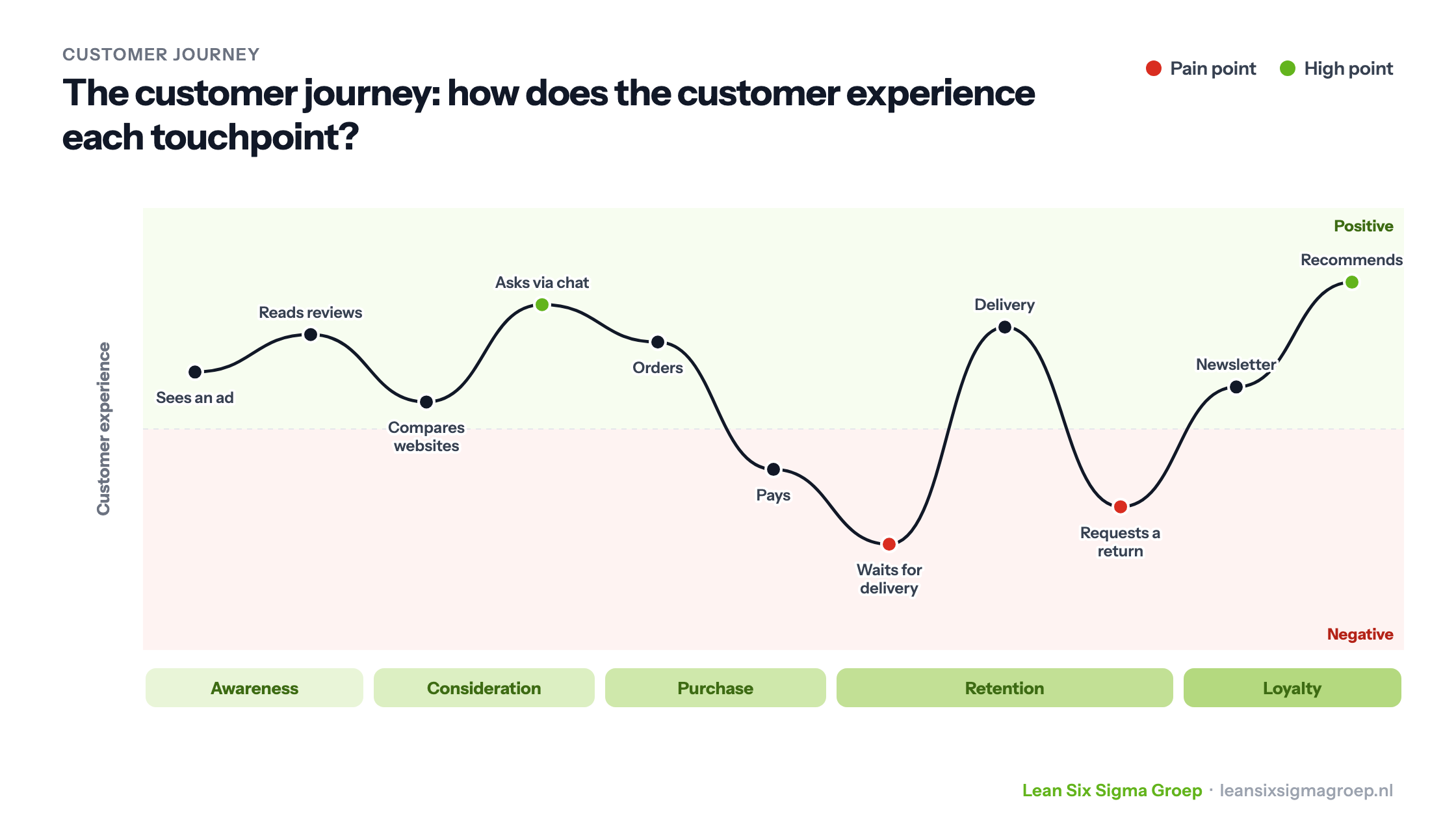
Why is the customer journey important?
The customer journey gives businesses valuable insight into their customers’ needs, emotions and pain points throughout the entire buying process. With those insights, businesses can:
- Improve the customer experience: by understanding how customers experience each touchpoint, businesses can optimise their services and processes to deliver a seamless, positive experience.
- Increase customer loyalty: by investing in a better customer experience, businesses can build loyalty, which leads to repeat purchases and positive word of mouth.
- Gain a competitive advantage: businesses that take the customer journey seriously and keep improving it can stand out from their competitors and build a strong position in the market.
Stages of the customer journey
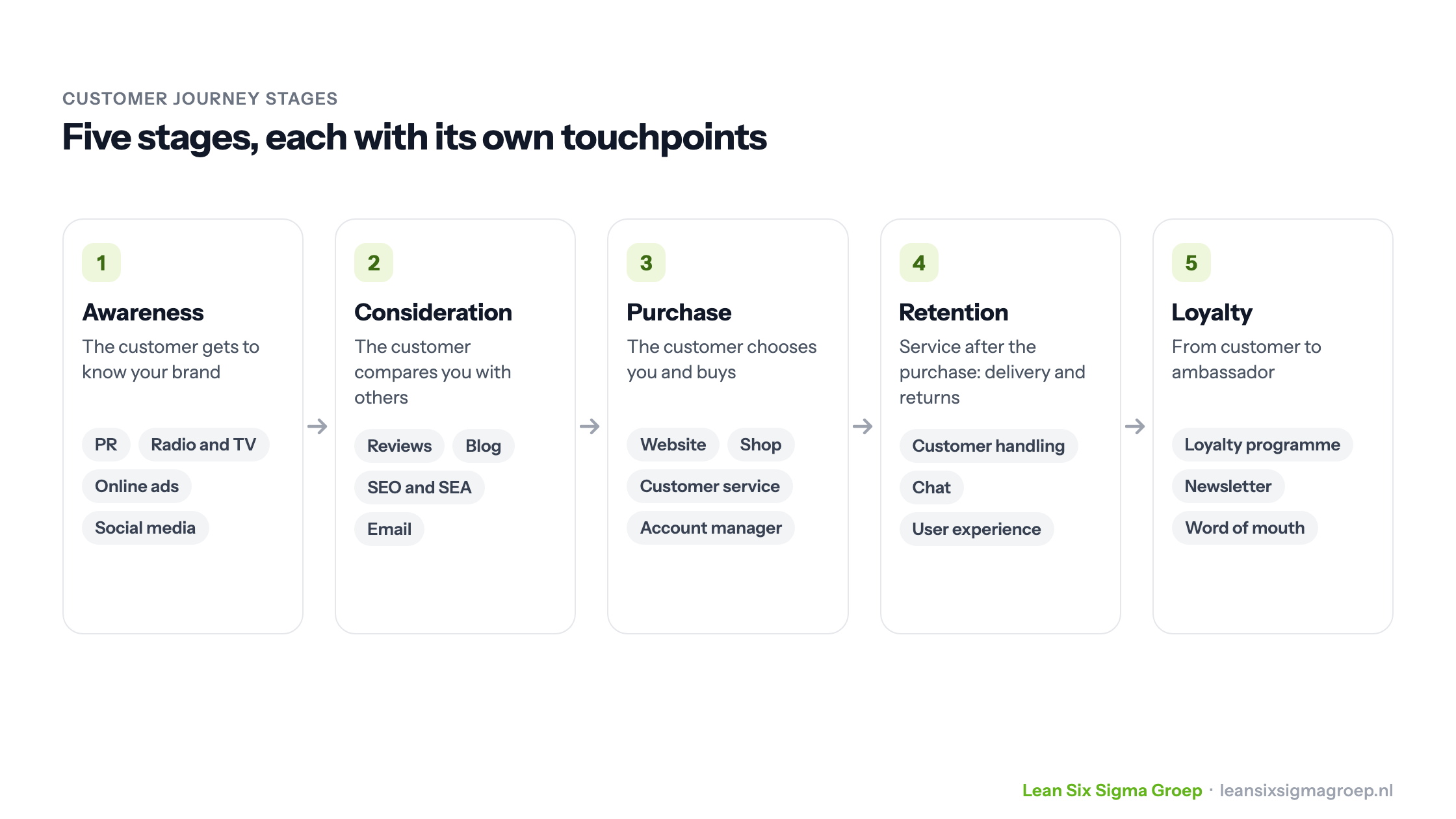
Here are the different stages of the customer journey, together with the matching customer relationship and touchpoints:
| Stage | Customer relationship | Touchpoints |
| Awareness | In the awareness stage, the customer comes into contact with your product, service or brand for the first time. | Online advertising and social media. |
| Consideration | In the consideration stage, the customer compares your brand with other brands to find the best match. | Clear communication of your unique selling points (USPs). |
| Purchase | In the purchase stage, the customer has chosen your brand. This is where the customer goes ahead and buys. | Retargeting through Google Ads and social media campaigns. |
| Retention | The retention stage focuses mainly on delivery and returns, in other words the service you provide after the purchase. | Delivery updates and free returns. |
| Loyalty | In the loyalty stage, your goal is to turn the customer into a loyal ambassador for your brand. This is all about building long-term customer relationships. | Asking for feedback and running loyalty programmes. |
Advantages of the customer journey
- Deep insight into customer behaviour: The customer journey gives businesses deep insight into their customers’ behaviour, needs and preferences throughout the entire buying process. This helps businesses understand how customers use their products or services and where improvements are needed.
- Customer-centric approach: By following the customer journey, businesses can take a more customer-centric approach in their marketing and sales strategies. They can focus on delivering a seamless, personalised experience that matches their customers’ needs and expectations.
- Better customer experience: By optimising the customer journey, businesses can improve the overall customer experience. This can lead to higher customer satisfaction, repeat purchases and positive word of mouth, which in turn can lead to higher revenue and profitability.
- Identifying pain points: The customer journey helps you identify pain points and bottlenecks in the buying process. By tackling those pain points, businesses can raise customer satisfaction and reduce the risk of losing customers.
Disadvantages of the customer journey
- Complexity: Mapping and optimising the customer journey can be a complex process, especially for businesses with a wide range of products, services and customer segments. It can produce a large amount of data and analysis work, which can be time-consuming and costly.
- Subjectivity: Understanding the customer journey often requires subjective interpretations of customer behaviour and emotions. This can lead to different insights and interpretations within an organisation, which in turn can cause conflict and make decisions harder to reach.
- Changing customer needs: Customer needs and preferences can change over time because of external factors such as technological developments, economic shifts and changing market trends. This can mean the customer journey has to be reviewed and updated regularly, which takes extra effort and resources.
- Return that is hard to measure: Measuring the return on investment in optimising the customer journey can be difficult, because it is often hard to draw a direct line between improvements in the customer experience and business results such as revenue growth and profitability.
Creating a customer journey
Creating an effective customer journey takes careful planning and execution. Here are some steps to develop a successful customer journey:
- Identify the customer journey: Define clearly which customer journey you want to visualise and which process steps are involved. Decide where the journey starts and ends, and identify the key touchpoints where customers interact with your business.
- Segment customer groups: Recognise that different customer groups have different needs and emotions. Segment your customer base and create a separate customer journey for each segment to offer a more personalised experience.
- Collect data: Gather as much data as you can to support your customer journey. Analyse customer behaviour, feedback and other relevant information to gain a deeper understanding of your customers’ needs and preferences.
- Focus on the highs and lows: Identify the high points and the challenges in the customer journey, and analyse what your business does at these crucial moments. Focus your improvement efforts on the touchpoints that have the biggest impact on the customer experience.
- Empathise with the customer: Put yourself in your customers’ shoes and try to understand what they really want and why. By showing empathy and taking their needs into account, you can design a customer journey that matches their expectations and emotions.
Customer journey example: IKEA
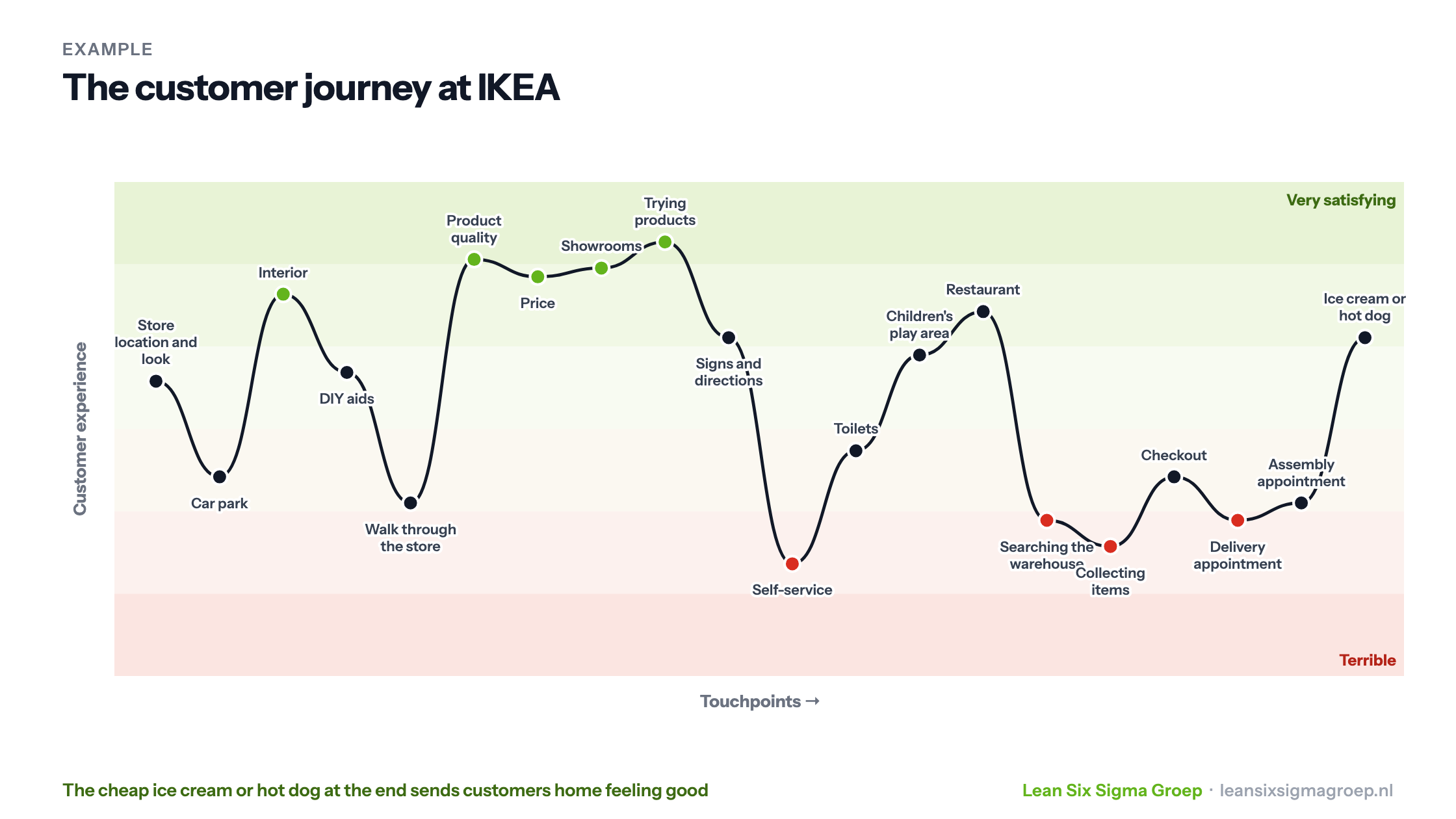
An often-quoted example of an organisation that improved its service with the customer journey is IKEA. Cheap snacks (an ice cream, a hot dog) at the end of the customer journey give customers the feeling that IKEA is a shop with good value for money. Whether that is actually true, I’ll leave open.
What IKEA has certainly achieved, by using insights from the customer journey, is that many customers head home with a good feeling.
Customer journey and Lean Six Sigma
A change philosophy such as Lean Six Sigma also likes to make use of the customer journey. It is used as a way to identify and shape what the customer wants. It is the benchmark for problems (for completeness: problems are the starting point of every change; no problem, no urgency or need).
After that, causes and solutions are sought to improve the service. So the customer journey is not only a stand-alone tool, it can also be built into change programmes.
Discover the power of the customer journey
The video below explains what a customer journey is: the journey a customer takes from the first contact through to after the purchase. Understanding the customer journey is essential for businesses that want to grasp customer needs and pain points and improve the customer experience. The video offers practical tips for creating and optimising a good customer journey.
If you want to build the skills to manage process improvements in your organisation well, feel free to sign up for a Green Belt or Black Belt course.
From theory to practice
Learn to apply this in practice
Topics like Customer journey are applied directly to an improvement project from your own organisation in the Green Belt training.
Next start dates
Lean Six Sigma Green Belt training →Not ready for a training yet?