In this article
The question comes up more and more often in conversations with teams, clients and training participants. Sometimes it is asked cautiously, sometimes bluntly: “If AI can carry out analyses, suggest causes and write reports, will we still need process improvers?“
It is an understandable question. The speed at which AI is developing is impressive. What used to take hours, structuring a problem, organising possible causes or writing a proposal, can now be generated in seconds. That makes people curious, but sometimes also uncertain.
Yet this question touches on something deeper than technology alone. Anyone who works on process improvement every day knows that the profession has never been only about tools or techniques. In the end it is about making change work, and that always happens with and through people.
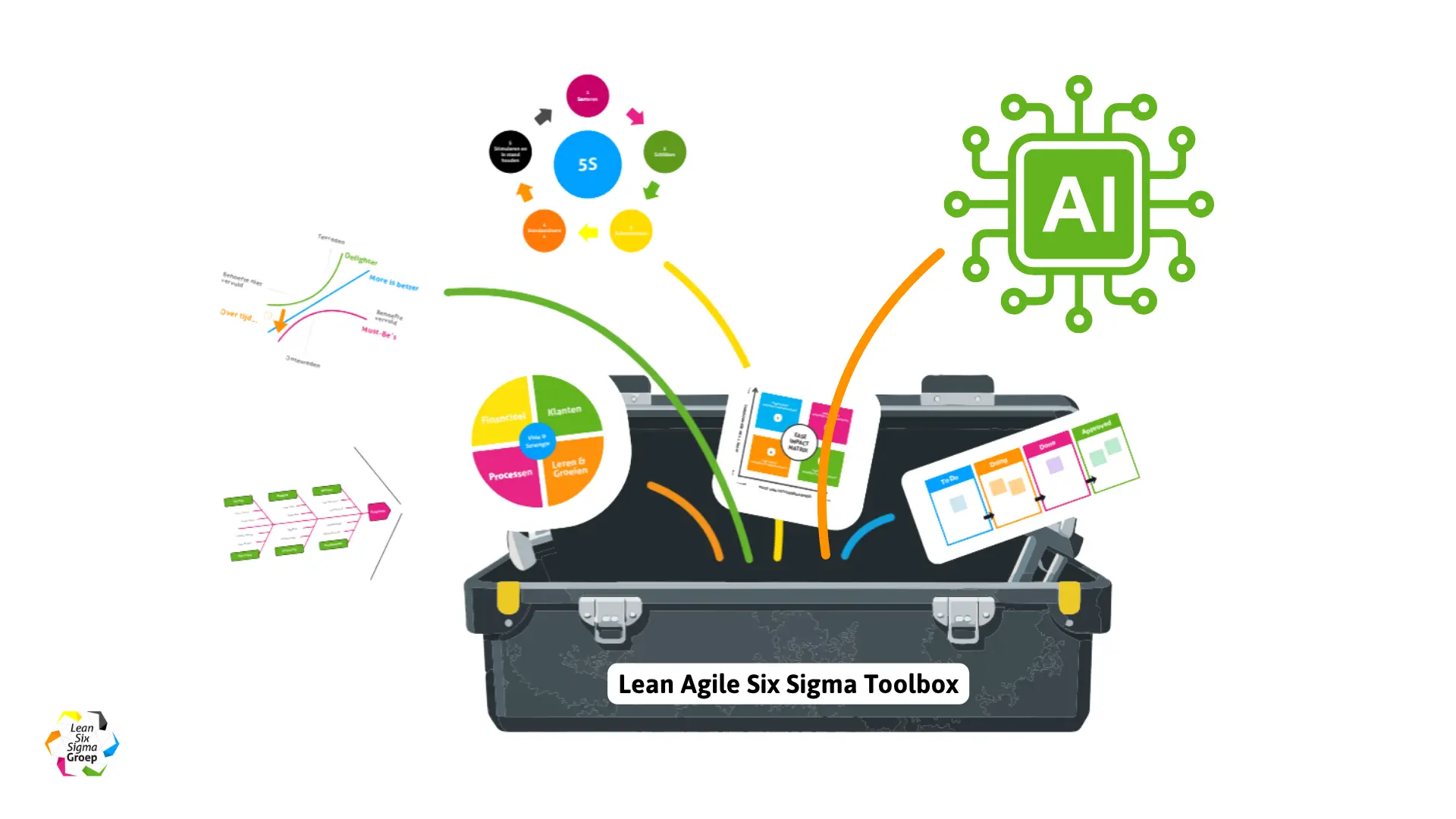
This is one of the tools you learn to apply in the Green Belt training.
More than a role: the craft of process improvement
Although people often talk about Green Belts or Black Belts, I prefer to speak of process improvers. Not because roles are unimportant, but because the work they do is broader than a certificate or a title.
A process improver helps an organisation get a sharp picture of what is really going on. Not only what is visible on the surface, but what lies beneath. Why does a process get stuck? Where do errors arise? Why does a problem keep coming back, even after it has been tinkered with several times?
That calls for structure and method, certainly. But above all it calls for understanding of people, processes and behaviour.
The structures and methods we use, such as DMAIC, fishbone diagrams, measurements and analyses, are aids. They help bring order to complexity. But they have never been a goal in themselves. They are meant to achieve something else: lasting improvement in how people work.
What AI visibly changes
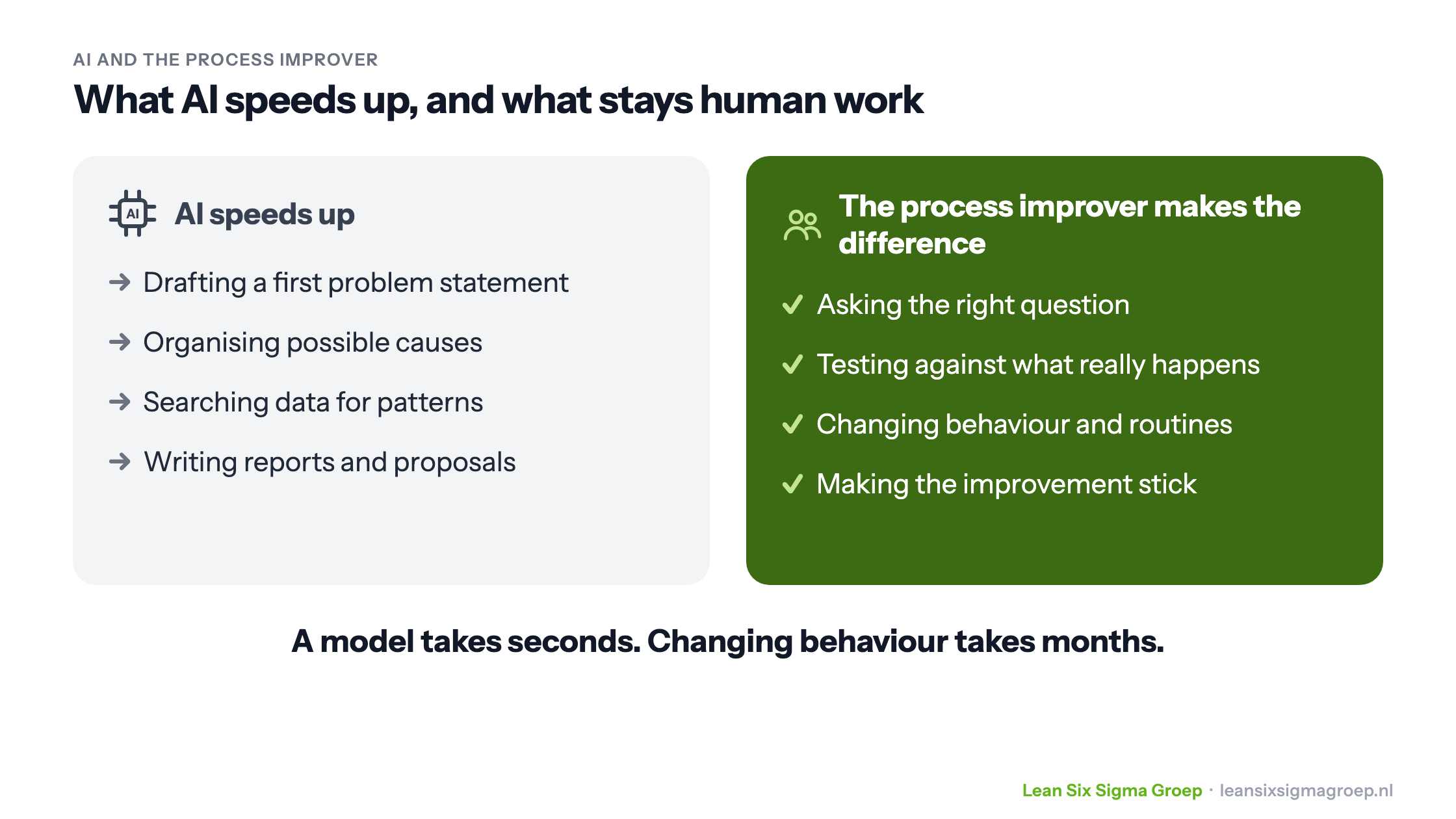
AI adds a new dimension. It makes certain steps faster and more accessible. A first draft of a problem statement can be generated in seconds. Possible causes can be organised quickly. Reports and proposals can be written faster than ever before.
Many process improvers recognise that a considerable part of their time used to go into preparatory work: structuring, organising, formulating. AI can speed that up. It can help make ideas visible, bring structure where it is still lacking, and reach a first workable version faster. But a first version is rarely the right version.
The real work often only starts after that: assessing, sharpening and testing against practice. Because processes don’t take place on paper, but in the daily reality of people who work together, make choices and follow routines.
Where the real challenge lies
Many improvement projects don’t get stuck because there are too few ideas. They get stuck because change is difficult. Not technically difficult, but humanly difficult.
New ways of working require people to adjust their behaviour. Routines have to change. Old habits have to be let go and new ones built. That takes time, trust and clarity. It also takes guidance. That is where a core part of the process improver’s craft lies. Not in building models, but in helping behaviour and routines change, and stay changed.
A model can be generated in seconds. Changing behaviour often takes months.
Tools are aids, not solutions
In Lean Six Sigma we have always worked with structures and aids: SIPOC, fishbone diagrams, control plans. They are means to get a grip on processes. But no aid solves a problem without people putting it to work. AI belongs in that same list. It is a powerful aid, perhaps one of the most powerful we have seen so far. But it remains an aid. Not a replacement for insight, experience or professional judgement.
In fact, precisely because AI can phrase things so convincingly, a new risk arises: that an answer sounds logical but is wrong. Or that an analysis looks good but rests on assumptions that were never tested.
That is where the role of the process improver comes to the fore again. Not as someone who carries out steps, but as a critical thinker. Someone who keeps asking questions, and wants to understand what really happens in the process.
The human component doesn’t get smaller, but more visible
When processes change, behaviour changes with them. And behaviour can’t be automated. People work on the basis of routines, habits and unspoken agreements. That makes processes stable, but sometimes also rigid. Improving often means questioning those routines and introducing new ways of working. That creates tension. Not because people are against improvement, but because change creates uncertainty. It touches on craftsmanship, trust and collaboration. That calls for guidance, explanation and involvement.
Here the human component plays at least as big a role as the technical one. Because in the end the goal of process improvement is not a nice model or a convincing analysis. The goal is that people start working differently, and that the change lasts.
AI as a partner rather than a replacement
If you look at AI from that perspective, the question shifts.
Not: does AI replace the process improver?
But: how can AI help the process improver deliver better work?
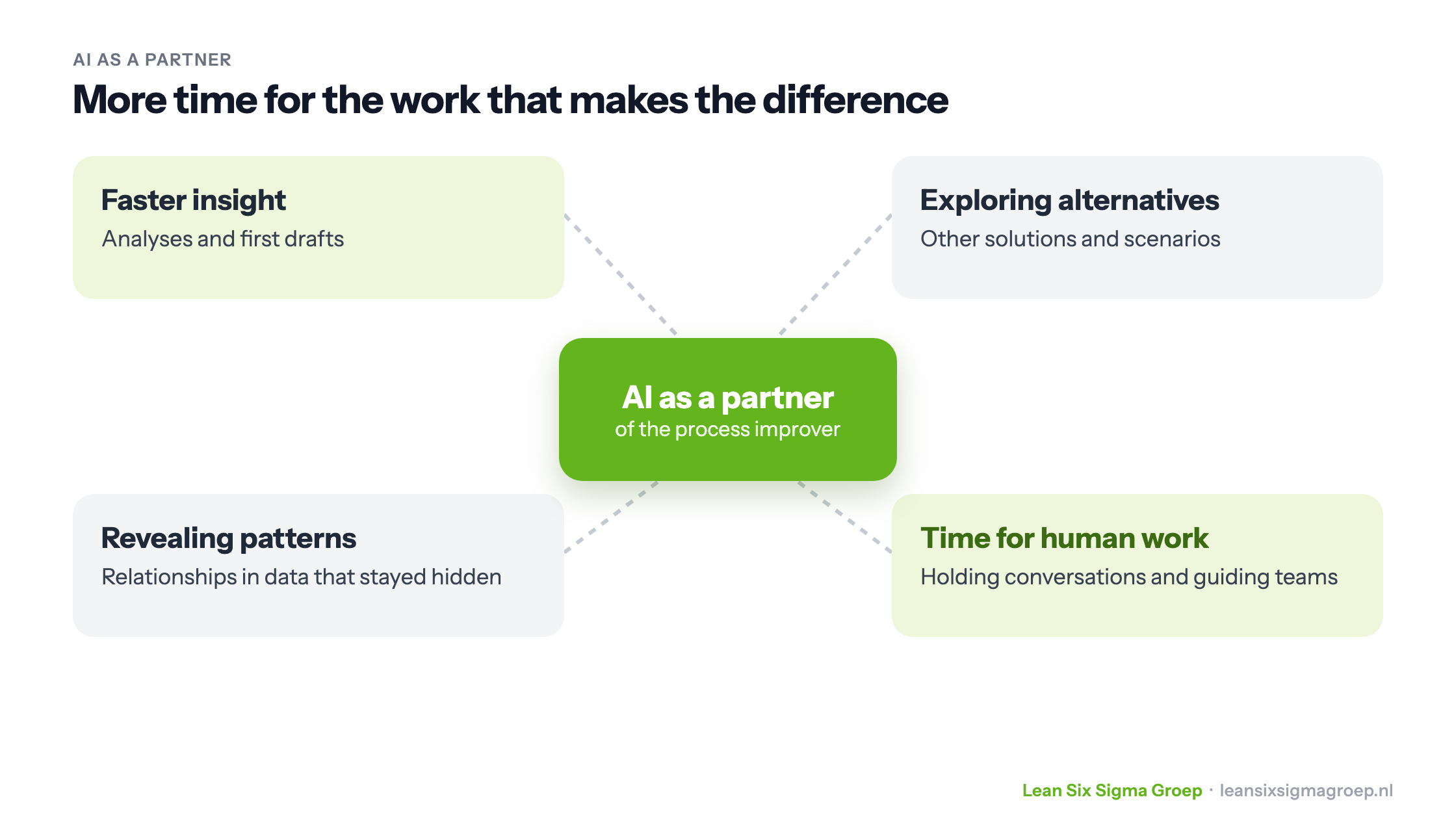
AI can help gain insight faster, explore alternatives, and reveal patterns that previously stayed hidden. It can free up time for what often makes the biggest difference: holding conversations, understanding what is going on, guiding teams. In that sense AI can actually strengthen the profession. Not by taking it over, but by creating room for the parts that are truly human.
What this means for the future of the profession
When things change, the profession changes with them. That has always been the case. New technologies have influenced the work of process improvers before. Think of statistical software, dashboards or digital workflows. Each time the same movement arose: first amazement, then experimentation, and finally integration. AI seems to be following a similar path.
The process improver of the future will probably spend less time producing first versions and more time assessing, interpreting and guiding change. Less on working out structures, and more on making sure structures really come alive in practice.
So: does AI make the process improver redundant?
Probably not. What AI does do is change the profession. Some parts get faster. Others become more important. And some take a different form. But the core stays the same. Process improvement is ultimately about changing people’s behaviour patterns and routines successfully and lastingly. That requires insight, involvement and craftsmanship.
AI can play a powerful role in that, as an aid, an accelerator, a sparring partner. But not as the only solution.
Going further
Want to learn more about the role of a process improver? Read What is a Green Belt? or take a look at our training courses.
From theory to practice
Learn to apply this in practice
Topics like Does AI make the Green Belt redundant are applied directly to an improvement project from your own organisation in the Green Belt training.
Next start dates
Lean Six Sigma Green Belt training →Not ready for a training yet?